case reviewStart now
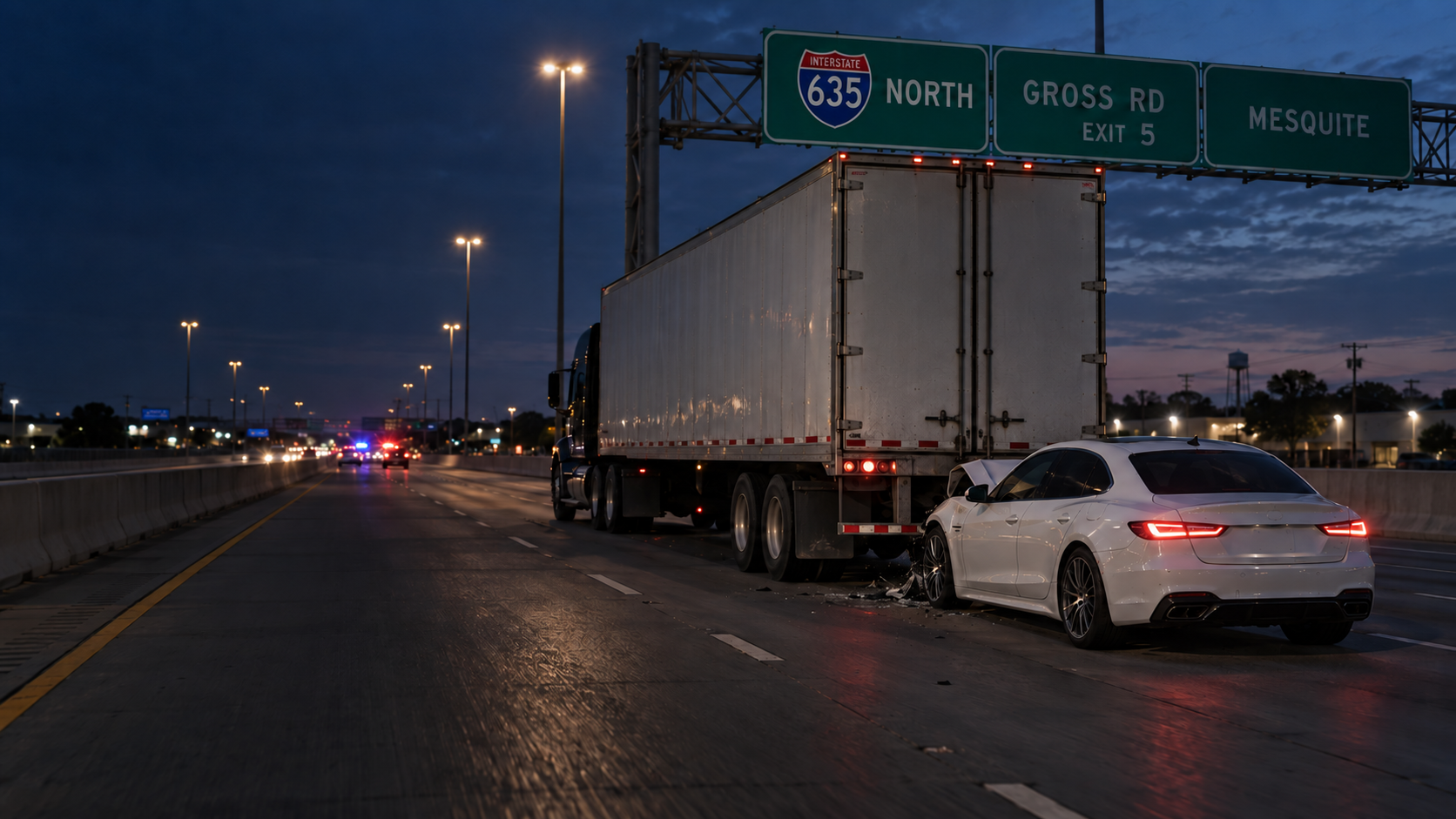
Mesquite IH-635 18-Wheeler Crash Lawyer
Fatal DWI semi-truck collision, northbound IH-635, September 9, 2026
If you lost a family member, were injured, or witnessed the crash in the 21100 block of northbound IH-635 early on September 9, this page is built for you rather than for readers looking for news. It separates what Mesquite police have confirmed from what is still unknown, explains every agency and company that may end up involved, and sets out the Texas deadlines and evidence that decide these cases. Nothing here is a legal conclusion about any person or company.
No fee unless we recover. Free and confidential. Contacting the firm does not create an attorney-client relationship until a written agreement is signed.
What is known, and what is not
A 36-year-old Dallas man, identified by police as Jose Aguilar Renteria, died at the scene after his white Alfa Romeo sedan struck the trailer of a slow-moving 18-wheeler at 3:17 a.m. on September 9.
The truck driver, identified as Ulises Mendez Hernandez, 30, of Mexico, was arrested at the scene and charged with driving while intoxicated. A charge is an accusation; guilt is decided by a court.
Why the 18-wheeler was moving slowly on an interstate at 3:17 a.m. has not been publicly explained. In a rear-of-trailer collision that question often matters more than any other.
No trucking company, trailer owner, broker or shipper has been named publicly. Until the motor carrier is identified, the insurance that would fund any recovery is unknown. How the carrier gets identified →
No court has found any person or company civilly liable. Texas juries apportion responsibility among everyone whose conduct contributed, and that apportionment has not been made here.
Truck data, driver logs and surveillance video are deleted on routine retention schedules — some within days. Preservation letters are the single most useful step a family can take this week. Evidence checklist →
- 01Main takeaways
- 02Incident facts table
- 03Detailed incident summary
- 04Latest investigation updates
- 05Every entity involved, explained
- 06Potentially liable parties
- 07Could the trucking company be liable?
- 08Criminal vs. civil investigation
- 09The Texas law that applies
- 10Attorney analysis
- 11Evidence preservation
- 12What to do now
- 13Possible compensation
- 14How Dunk Law Firm helps
- 15Incident-specific FAQs
- 16Official & primary sources
- 17Legal reviewer & disclaimers
The crash on the record
Every row below carries its source and its status. Rows marked not publicly reported are the gaps a civil investigation is built to close — they are not omissions by police, only facts that have not been released while the Traffic Unit works.
| Item | What the record shows | Status | Source |
|---|---|---|---|
| Date | Tuesday, September 9, 2026 | Confirmed | Mesquite PD via FOX 4 |
| Time | 3:17 a.m. — police response time | Confirmed | Mesquite PD via FOX 4 |
| Location | 21100 block of northbound Interstate 635, near North Gross Road, Mesquite, Dallas County | Confirmed | Mesquite PD via FOX 4 |
| Vehicle 1 | White Alfa Romeo sedan | Confirmed | Mesquite PD via FOX 4 |
| Vehicle 2 | 18-wheeler (tractor-trailer), described as slow-moving | Confirmed | Mesquite PD via FOX 4 |
| Collision type | Sedan struck the trailer of the 18-wheeler | Confirmed | Mesquite PD via FOX 4 |
| Fatality | Jose Aguilar Renteria, 36, of Dallas — driver of the sedan; died at the scene | Confirmed | Mesquite PD via FOX 4 |
| Truck driver | Ulises Mendez Hernandez, 30, of Mexico | Confirmed | Mesquite PD via FOX 4 |
| Arrest / charge | Arrested at the scene; charged with driving while intoxicated | Confirmed | Mesquite PD via FOX 4 |
| Investigating agency | Mesquite Police Department Traffic Unit — investigation continuing | Confirmed | Mesquite PD via FOX 4 |
| Motor carrier | Not publicly identified | Unknown | — |
| Trailer owner / lessor | Not publicly identified | Unknown | — |
| Cargo, shipper, broker | Not publicly reported | Unknown | — |
| Why the truck was slow | Not publicly reported — mechanical issue, merging, traffic, disabled vehicle and lane position have not been addressed publicly | Unknown | — |
| Lighting, reflectors, hazard warnings | Not publicly reported | Unknown | — |
| Toxicology / BAC results | Not publicly reported | Unknown | — |
| Additional injuries | No other injuries reported in the initial account | Developing | Mesquite PD via FOX 4 |
| Civil liability | No finding of liability against any party | Not established | — |
Attribution note: the initial public account of this crash comes from the Mesquite Police Department, reported by FOX 4 Dallas-Fort Worth on September 13, 2026. If you have information that corrects any row above — including photographs of the truck, its markings, or the scene — please tell us at intake@slamdunklawyer.com so the page can be corrected.
What happened, in sequence
Shortly after three o'clock on the morning of Tuesday, September 9, 2026, a white Alfa Romeo sedan travelling northbound on Interstate 635 in Mesquite collided with the trailer of a tractor-trailer that police described as slow-moving. Mesquite police responded at 3:17 a.m. to the 21100 block of the northbound lanes, near North Gross Road. The driver of the sedan, 36-year-old Jose Aguilar Renteria of Dallas, died at the scene.
Officers arrested the driver of the 18-wheeler at the scene. Police identified him as 30-year-old Ulises Mendez Hernandez of Mexico and charged him with driving while intoxicated. The Mesquite Police Department Traffic Unit continues to investigate. That is the extent of what has been publicly released.
Two details in that short account carry unusual weight. The first is the hour: 3:17 a.m. is inside the window when both fatigue-related and alcohol-related crashes cluster, and when the visual cues a driver relies on to judge a large vehicle's speed are weakest. The second is the phrase slow-moving. On a freeway where prevailing speeds run 60 to 70 miles per hour, a trailer travelling well below that speed presents a closing-speed problem that a following driver may have only a second or two to solve.
In a collision where a passenger car strikes the rear or side of a trailer, the reflexive assumption is that the following driver is at fault. Texas law does not work that way. Fault is apportioned among everyone whose conduct contributed, and a trailer that was underlit, unmarked, stopped, disabled or illegally slow can carry a substantial share.
Federal rules govern how visible a trailer must be after dark — lamps, reflectors and retroreflective sheeting — and how a commercial driver must warn traffic if the vehicle stops on a travelled roadway. Whether those rules were met here is unknown and is exactly what a civil investigation would examine.
Nothing about the DWI charge answers the geometry question. The criminal case asks whether the driver was intoxicated. The civil case asks what each vehicle was doing, and why.
Latest updates, newest first
This log records public developments and, honestly, the absence of them. Entries are added as agencies release information; each carries the date it entered the record.
- Sept 14, 2026
Account restated without change; no new facts released
The "what we know" account circulating on September 14 is unchanged from the original release: same response time of 3:17 a.m., same location in the 21100 block of northbound IH-635 near North Gross Road, the same two vehicles, the same identifications of both drivers, and the same DWI charge. Nothing has been revised and nothing has been added.
Still not released: any motor carrier, trailer owner or shipper; toxicology or blood-alcohol results; an explanation of why the 18-wheeler was moving slowly; the trailer's lighting and reflector condition; and any court date. The Traffic Unit's reconstruction remains open. The Texas peace officer's crash report (form CR-3) is typically available through TxDOT's Crash Report Online Purchase System within roughly ten days of the crash.
- Sept 13, 2026
First public account published
FOX 4 Dallas-Fort Worth reported the crash, the identities of both drivers, and the DWI charge, sourced to the Mesquite Police Department. This is the origin of nearly every fact currently in the public record.
- Sept 9, 2026
Crash, fatality, and arrest at the scene
Police responded at 3:17 a.m. The sedan's driver died at the scene. The truck driver was arrested and charged with DWI. Under federal rules, a commercial driver involved in a fatal crash is subject to post-accident alcohol and controlled-substance testing within defined time limits — whether and when that testing occurred has not been publicly stated.
Have information we don't? Dashcam footage, a photograph of the truck's door markings, or an account of the traffic conditions that night can change the direction of an investigation.
Send what you haveEvery agency and company in this case, explained
Fatal truck crashes pull in agencies with different powers and companies with different insurance. Knowing who does what tells a family where information lives and who has to be put on notice. Listing an entity here says nothing about fault.
Mesquite Police Department Traffic Unit
The lead investigator. It reconstructs the collision, took the arrest decision at the scene, and produces the Texas CR-3 crash report that becomes the backbone of any civil claim. Its scene photographs, measurements and body-camera footage are held on records-retention schedules and obtained through open-records requests.
Dallas County District Attorney's Office
Decides whether to present the DWI charge to a grand jury and whether the charge is upgraded — Texas treats intoxication manslaughter as a separate second-degree felony where a death results. The criminal case belongs to the State, not to the family; a family's civil claim runs on a separate track.
Dallas County Medical Examiner
Determines cause and manner of death and performs toxicology. The autopsy report documents injury mechanism, which matters in a rear-of-trailer case where underride versus frontal crush can distinguish competing accounts of the collision.
Texas Department of Transportation (TxDOT)
Custodian of the statewide crash records system and of the roadway itself. Its files cover lane configuration, construction or lane-closure activity on IH-635 that night, signage, lighting and prior crash history at the location.
FMCSA (U.S. DOT) and Texas DPS commercial enforcement
The Federal Motor Carrier Safety Administration registers interstate carriers and publishes their inspection and crash histories through SAFER and the Safety Measurement System. DPS troopers conduct commercial-vehicle inspections in Texas. Once a carrier is named, these databases show whether it had a documented pattern of hours-of-service, maintenance, or drug-and-alcohol violations.
The motor carrier (trucking company)
The company that employed or contracted the driver and held operating authority for the trip. In most fatal truck cases the carrier and its insurer are the substantive defendants because of the size of the policies involved. No carrier has been publicly identified here. How it gets identified →
Trailer owner, lessor, or maintenance contractor
Trailers are frequently owned by a different company than the tractor — leasing firms, drayage pools, shippers. Because trailer lighting, reflective tape and the rear impact guard are at the centre of a rear-of-trailer case, whoever owned and maintained the trailer is a distinct question from who employed the driver.
Shipper, freight broker, or logistics intermediary
Whoever arranged the load can matter when a schedule made lawful driving impossible, when a broker selected a carrier with a poor safety record, or when loading affected the trailer's stability or lighting. Whether any intermediary existed here is unknown.
Any establishment that served alcohol
Texas has a dram shop statute permitting claims against a licensed provider that served an obviously intoxicated person who then caused harm. That claim exists only if alcohol was obtained from a licensed provider and only on proof of the statute's narrow requirements. Nothing in the public record identifies where, or whether, alcohol was served.
Alfa Romeo / Stellantis — the sedan's manufacturer
Named here only because the vehicle brand appears in the police account. There is no indication of any vehicle defect, no recall has been connected to this crash, and nothing suggests manufacturer involvement. In severe-crash cases counsel routinely check recalls and preserve the vehicle so that occupant-protection performance can be ruled in or out; that is standard diligence, not an allegation.
The commercial and personal auto insurers
Interstate motor carriers must carry minimum federal financial responsibility, typically $750,000 and often far more, and large fleets add excess layers. The family's own uninsured/underinsured motorist and PIP coverage may also apply. Insurers begin investigating within hours, which is why families should not give recorded statements before they have counsel.
Who could be legally responsible
These are recognised legal theories, not accusations. Each one has to be proven with evidence that does not yet exist in the public record, and several may turn out not to apply at all. No party named or described on this page has been found liable by any court.
| Potential party | Legal theory | What would have to be proven | Current status |
|---|---|---|---|
| The truck driver | Negligence; negligence per se from traffic and federal safety violations; gross negligence if conduct showed extreme risk taken knowingly | That he operated the vehicle unsafely or while impaired and that this was a proximate cause of the death. The DWI charge is evidence relevant to this, not a substitute for proving it. | Charged criminally; no civil finding |
| The motor carrier | Vicarious liability for an employee driver acting in the course of employment; independent negligence in hiring, training, supervision, retention and entrustment | The employment or agency relationship, and for direct claims, that the carrier knew or should have known of a risk — prior violations, failed or skipped drug and alcohol testing, unrealistic scheduling, ignored complaints. | Carrier not yet identified |
| Trailer owner / maintenance provider | Negligent maintenance; failure to keep required lamps, reflectors and rear impact guard in compliant condition | That required lighting or conspicuity equipment was missing, dirty, obscured or inoperative, or that a rear guard failed, and that a compliant condition would likely have changed the outcome. | Owner not yet identified |
| Shipper / broker / logistics company | Negligent selection of carrier; negligent loading; scheduling that made compliant driving impracticable | That an intermediary existed, that it had a duty in the circumstances, and that its choices contributed. Broker liability is contested and varies by jurisdiction. | Speculative — no intermediary identified |
| A licensed alcohol provider | Texas Dram Shop Act (Alcoholic Beverage Code §2.02) | That a licensed provider sold or served to a person already obviously intoxicated to the extent he presented a clear danger to himself and others, and that the intoxication was a proximate cause. | Speculative — no provider identified |
| A roadway or work-zone entity | Premises or roadway defect claims, subject to governmental immunity and the Texas Tort Claims Act | Lane closure, debris, signage or a construction condition that contributed. Claims against governmental units carry short formal notice deadlines and damage caps. | Speculative — no work zone reported |
| Third vehicles or conditions | Negligence of an unidentified driver; phantom-vehicle claims under UM coverage | Evidence that another vehicle caused the truck to slow or the sedan to be positioned as it was. No such vehicle has been reported. | Speculative |
Texas uses proportionate responsibility. A jury assigns a percentage to every party, including the person who died, and recovery is barred entirely if the claimant's share exceeds fifty percent. In a case where a car struck a trailer, the defence will argue exactly that. This is why the truck's own conduct — its speed, its lane, its lighting, its reason for being slow — is not a side issue but the centre of the case.
Could the trucking company face liability — and who is it?
This is the question families ask first, and in this case it has to be answered in two parts, because no trucking company has been publicly identified. The police account names the two drivers and nothing else. That gap is normal at this stage and it is closeable.
Part one: could a carrier be liable at all?
In principle, yes — and in fatal DWI truck cases the carrier is usually the more consequential defendant, for two reasons that have nothing to do with sympathy.
Vicarious liability. An employer is generally answerable for the negligence of an employee acting within the scope of employment. If the driver was an employee on a company trip, the carrier's exposure follows the driver's conduct automatically, without any proof of fault by the company itself. Whether he was an employee, an owner-operator, or a contractor under someone else's authority is unknown and is a threshold fact.
Independent corporate negligence. Separate claims target the company's own decisions: negligent hiring of a driver whose record showed risk; failure to run the pre-employment and random drug-and-alcohol testing federal rules require; failure to act on a positive test, a refusal, or a prior incident; inadequate supervision; and scheduling that pushed a driver past the hours-of-service limits. Federal regulations flatly prohibit a commercial driver from operating with alcohol in the system and require post-accident testing after a fatal crash. Whether the carrier here complied is unknown.
Both theories are theories. A DWI arrest of a driver does not, by itself, establish that any company did anything wrong, and a carrier with a clean compliance file may have a strong answer to the direct-negligence claims while still being answerable vicariously.
Part two: how the carrier gets identified
Identifying the company is a documents exercise, and it is usually finished within days once someone starts asking. In order of speed:
- 01
Scene photographs. Federal rules require the carrier's legal name and USDOT number to be displayed on both sides of the tractor. Any photograph or dashcam frame of the truck that night is likely to resolve the question immediately.
- 02
The Texas CR-3 crash report. The peace officer's report records the commercial vehicle's carrier name, USDOT or MC number, unit configuration, cargo and insurance, and is obtainable from TxDOT's crash-report system, typically about ten days after the crash.
- 03
Open-records requests. Requests to Mesquite PD for the offence report, scene photographs, body-camera and dash-camera footage, the tow and impound records, and any commercial-vehicle inspection performed that night. The tow record alone usually names the carrier that reclaimed the tractor.
- 04
FMCSA databases. With a name or DOT number, SAFER and the Safety Measurement System return the carrier's authority status, fleet size, insurance filings, inspection history and crash record — the raw material of a direct-negligence claim.
- 05
Litigation tools. If records are withheld, a petition and subpoenas reach the driver qualification file, electronic logs, the lease and interchange agreements, the trailer's ownership chain, and the insurance policies. A cross-border operation adds questions about which authority governed the trip, which the lease documents answer.
The page will be updated if and when a carrier is publicly identified. Until then this section deliberately names no company.
Government investigation vs. civil investigation
Families often assume the police investigation will produce everything they need. It will not, because it is not designed to. The two investigations ask different questions, answer to different people, and end at different times.
| Government / criminal investigation | Civil investigation for the family | |
|---|---|---|
| Who runs it | Mesquite PD Traffic Unit; Dallas County DA; TxDOT and FMCSA for records and compliance | The family's own lawyers, with a reconstruction engineer, a commercial-vehicle expert and a records team |
| Question asked | Did a person commit a crime, and can the State prove it? | Which parties' conduct contributed, in what proportion, and what were the losses? |
| Who the client is | The State of Texas. The family are witnesses, not parties. | The family. The investigation is directed by and for them. |
| Standard of proof | Beyond a reasonable doubt | Preponderance of the evidence; clear and convincing for exemplary damages |
| Reaches companies | Rarely. Charges are brought against individuals; corporate compliance is examined only incidentally. | Directly. Carrier files, logs, maintenance records, leases and insurance are the core targets. |
| Evidence powers | Warrants, blood draws, compelled testimony | Preservation letters, subpoenas, depositions under oath, court-ordered inspection of the vehicles |
| Speed | Months to years; a grand jury may not act quickly | Must begin in days — physical evidence and digital data are being lost now |
| What a family gets | A conviction, a plea, a dismissal, and possibly court-ordered restitution — usually limited | Compensation for the losses the law recognises, and answers about how the crash happened |
| Effect on the other | A conviction can be useful evidence in the civil case; an acquittal or dismissal does not end it | The civil case does not affect the criminal charge, and cannot force or prevent a prosecution |
The practical consequence: waiting for the criminal case to finish is usually the costliest decision a family can make, because the civil evidence window closes long before a prosecution does.
The Texas rules that decide this case
General statements of Texas law, not advice about any particular claim. Statutes are amended and courts reinterpret them; confirm the current text and how it applies to your facts with a licensed Texas lawyer.
Two-year limitations period
Texas Civil Practice & Remedies Code §16.003 generally gives two years from the date of death for a wrongful death action and two years from injury for a personal injury action. Exceptions exist in both directions, and claims involving a governmental unit require formal notice far sooner. Treat the deadline as immediate rather than distant.
Texas Wrongful Death Act (§§71.002–71.004)
The statutory beneficiaries are the surviving spouse, children and parents of the deceased. Siblings and other relatives cannot bring the claim in their own right. If no beneficiary files within three months of death, the executor or administrator of the estate generally must, unless a beneficiary requests otherwise.
Survival action (§71.021)
A separate claim belonging to the estate for what the deceased person himself suffered — conscious pain and mental anguish before death, medical expenses and funeral costs. It is brought alongside the wrongful death claim and is often overlooked when families handle matters without counsel.
Proportionate responsibility (Chapter 33)
A jury assigns a percentage of responsibility to each party, including the deceased. Recovery is barred if the claimant's percentage exceeds 50 percent, and is otherwise reduced by that percentage. Defendants above 50 percent can be jointly and severally liable. This rule is why the trailer's visibility and speed matter so much here.
Exemplary damages (Chapter 41)
Available only on clear and convincing evidence of fraud, malice or gross negligence, and generally capped by a statutory formula. Texas law also provides that the cap does not apply where the harm results from certain felonious conduct, including intoxication manslaughter — a provision that can matter greatly in a DWI fatality, and one that depends entirely on facts not yet established here.
Dram Shop Act (Alcoholic Beverage Code §2.02)
Permits a claim against a licensed provider that served a person who was obviously intoxicated to the point of presenting a clear danger, where that intoxication proximately caused the harm. The statute is narrow, providers have a statutory safe harbour tied to employee training, and no provider has been identified in this incident.
Respondeat superior, negligent entrustment, negligent hiring
Texas recognises employer responsibility for employees acting in the scope of employment, and separate direct claims where a company entrusted a vehicle to an unlicensed, incompetent or reckless driver it knew or should have known about. Owner-operator and lease arrangements complicate but do not automatically defeat these claims.
Federal Motor Carrier Safety Regulations
49 C.F.R. Parts 382, 391, 392, 393 and 395 govern alcohol and drug prohibitions and testing, driver qualification, safe operation, required lamps and reflectors, and hours of service. A proven violation can support negligence per se and is the usual route to evidence of a company's systemic failures.
Spoliation
Texas courts may impose remedies where a party with a duty to preserve evidence destroys it, but the standard is demanding and remedies are discretionary. The practical protection is not a later sanction; it is a preservation letter delivered before the data is gone.
DWI and intoxication manslaughter
Under the Texas Penal Code, intoxication manslaughter is charged where a person, while intoxicated, operates a vehicle and by reason of that intoxication causes another's death by accident or mistake; it is a second-degree felony. Whether the filed DWI charge is presented or enhanced is the District Attorney's decision, not the family's.
UM/UIM and PIP
Texas policies include personal injury protection and uninsured/underinsured motorist coverage unless waived in writing. These can matter if a carrier's insurance is inadequate, contested, or if coverage questions arise from a lease or cross-border operation. Notice deadlines in the policy itself are often shorter than the statute of limitations.
Status is not a bar to recovery
A person's immigration status does not prevent a family from bringing a wrongful death or survival claim in Texas, and courts restrict attempts to put status before a jury. Families should not be deterred from asserting a claim on that basis.
Analysis: the five questions this case turns on
Original analysis by the Dunk Law Firm trial team, based solely on the public record as of September 14, 2026, 9:15 a.m. CDT. These are the lines of inquiry we would open, framed as questions because the answers are not known. None of this is a conclusion about any person or company, and none of it is advice about your claim.
Why was an 18-wheeler slow-moving on a freeway at 3:17 a.m.?
This is the first question we would ask, and the public record does not answer it. A tractor-trailer well below prevailing freeway speed is doing one of a handful of things: it is disabled or losing power, it is merging or exiting, it is caught in a slowdown, it is overloaded on a grade, or the driver's control is compromised. Each of those has a different legal consequence, and several point at the truck and its maintenance rather than at the following driver.
The answer is not a matter of speculation — it is recorded. The engine control module logs road speed, throttle, brake application and fault codes. Telematics and electronic logging data show the vehicle's speed profile across the minutes before impact. That data exists today and may not exist next month.
Was the trailer visible as a trailer?
Rear-of-trailer collisions at night are a well-documented failure mode precisely because a dark trailer side or rear can read to an approaching driver as empty road. Federal rules require specific lamps, reflectors and retroreflective sheeting on trailers, and require rear impact guards on most trailers built after the mid-1990s. Those requirements only work if the equipment is present, clean, powered and intact.
We would want the trailer photographed and physically inspected before it is washed, repaired or returned to service: which lamps were working, whether the conspicuity tape was intact or grimed over, whether the rear guard was fitted and whether it performed. A post-crash inspection report or a DPS commercial-vehicle inspection from that night, if one was performed, would be among the most valuable documents in the case.
What does the DWI charge actually establish for a civil claim?
Less than families expect, and more than defendants would like. A charge is an accusation. It does not establish intoxication, and it certainly does not establish that intoxication caused this collision — causation is a separate element, and a defence lawyer will argue that an impaired driver travelling slowly in his own lane did not cause a car to strike his trailer.
What the charge does is open doors. It makes the arrest report, the field sobriety documentation, the blood or breath results and the officers' body-camera footage identifiable and obtainable. Federal rules also required post-accident testing of the commercial driver after a fatal crash; whether it was performed, when, and by whom is a question that reaches past the driver and into the carrier's compliance system.
Where does the comparative-fault fight land?
Squarely on the sedan's driver, who cannot answer for himself. The defence will argue inattention, speed, or impairment, and will point to the physical fact that the car struck the trailer. Texas's fifty-percent bar means this is not a haggle over a discount; it is a question of whether a family recovers anything at all.
Answering it requires reconstruction: closing speeds derived from crush and scene evidence, sight-distance and conspicuity analysis for the actual lighting conditions on that stretch of IH-635, the sedan's own event data recorder, and any dashcam or surveillance footage. This is the work that has to be commissioned early, because the scene evidence and both vehicles are perishable.
Which insurance actually responds — and under whose authority was the trip run?
Police identified the truck driver as a resident of Mexico. That may mean nothing more than where he lives, but it raises the ordinary set of commercial-trucking coverage questions that a family cannot answer without documents: whose operating authority governed the load, whether the tractor was leased to a carrier, who owned the trailer, whether a trip lease or interchange agreement shifts responsibility, and which policies and excess layers sit above the federal minimum.
These are contract and filing questions, answered by the lease, the certificate of insurance, the FMCSA filings and the bill of lading. They are also the questions most likely to be quietly resolved in the defendants' favour if nobody asks them in the first weeks.
What we are not saying. We are not saying the truck driver caused this crash, that any company was negligent, or that the family has a viable claim. We do not know. Every statement above is a question we would investigate, and the honest position two days after the first public report is that the decisive facts are still in the vehicles, the data and the files.
What is disappearing, and how fast
Nothing on this page is more urgent than this section. Commercial vehicles return to service, data is overwritten on routine schedules, and retention periods run whether or not a family has hired a lawyer. A written preservation demand — a spoliation letter — puts the holders of this material on notice that it must be kept.
| Evidence | Held by | Typical window | Why it matters here |
|---|---|---|---|
| Engine control module / event data recorder (truck) | Carrier, repair shop, or salvage yard | Days | Speed, throttle, braking and fault codes in the seconds before impact — the direct answer to "why was it slow?" |
| Telematics and GPS records | Carrier and its telematics vendor | Days to weeks | Speed profile across the trip; stops; route; harsh-event alerts |
| Electronic logging device (ELD) records | Carrier | 6 months minimum retention | Hours of service, duty status, fatigue, and whether the trip was lawful |
| Roadside and business surveillance video | TxDOT, City of Mesquite, nearby businesses | 7–30 days | May capture the truck's speed and lighting, and the moments before impact |
| The trailer itself — lamps, reflective tape, rear guard | Trailer owner or carrier | Until repaired or returned to service | Conspicuity is the central liability question in a rear-of-trailer case |
| The sedan and its event data recorder | Tow yard, insurer, or salvage | Weeks — vehicles are sold for salvage quickly | Pre-impact speed, braking and seatbelt status; occupant protection performance |
| Driver qualification file, drug and alcohol testing records | Carrier | Varies by regulation | Hiring, licensing, medical certification, prior violations, post-accident testing |
| Maintenance and inspection records | Carrier and maintenance contractor | Varies by regulation | Whether lighting and brake defects were known and unrepaired |
| Bill of lading, lease and interchange agreements | Carrier, shipper, broker | Contract-dependent | Identifies the load, the authority under which it moved, and who insured it |
| Police scene photographs, body-worn and dash camera footage | Mesquite Police Department | Agency retention schedule | Scene geometry, statements made at the scene, the condition of both vehicles |
| Witness recollection and contact details | Individual witnesses | Degrades immediately | 3:17 a.m. witnesses are few, hard to find later, and their memory of lighting fades fastest |
Preservation letters can go out within a day. They do not commit a family to a lawsuit and they do not cost anything. They simply stop the clock on material that is otherwise deleted on schedule.
Request preservation lettersPractical steps for families and witnesses
In rough order of urgency. Several of these protect a claim regardless of whether a family ever hires a lawyer.
- 01
Do not give a recorded statement to any insurer
Adjusters for a commercial carrier are investigating liability, not assisting you. You are not required to give a statement to another party's insurer. Get the request in writing and set it aside.
- 02
Do not sign anything, and do not accept an early payment
Releases and medical authorisations signed in the first weeks can close a claim for a fraction of its value or hand over records that have nothing to do with the crash.
- 03
Get preservation letters out to every holder of evidence
The carrier once identified, the tow and salvage yards holding both vehicles, TxDOT and the City for camera footage, and nearby businesses. This is the single most time-critical step.
- 04
Locate both vehicles and stop their disposal
Find out which tow operator took each vehicle and where it is stored. Salvage sales and repairs can destroy the physical evidence a reconstruction depends on.
- 05
Order the crash report and request the police file
The Texas CR-3 report is available through TxDOT's crash-report system, typically about ten days after the crash. Open-records requests to Mesquite PD cover photographs, camera footage and the arrest documentation.
- 06
Keep every document and receipt in one place
Funeral and burial invoices, medical bills, the death certificate, pay records establishing the deceased's earnings, and correspondence from any insurer.
- 07
Write down what you know while it is fresh
If you were a witness, note the lane the truck was in, whether its lights and reflectors were visible, its speed relative to traffic, weather and lighting, and anything said at the scene.
- 08
Notify your own insurer without admitting fault
UM/UIM and PIP coverage often carry policy notice deadlines shorter than the statute of limitations. Report the loss; leave the liability analysis to counsel.
- 09
Sort out who has authority to act for the estate
Wrongful death and survival claims belong to different people. Identifying the statutory beneficiaries and, where needed, an estate representative early prevents disputes that delay everything.
- 10
Speak to a lawyer this week, even if only to ask questions
A consultation costs nothing and commits you to nothing. The value of the first conversation is almost entirely about preservation, not litigation.
What Texas law allows a family to recover
Categories the law recognises, not a prediction. We publish no dollar figures and no averages for this incident: outcomes depend on liability, apportionment, available insurance and evidence that has not yet been gathered. Any lawyer quoting a number now is guessing.
Losses to the surviving family
Lost earning capacity and the financial support the deceased would have provided; lost household services; lost inheritance; and the family's own mental anguish, loss of companionship and loss of society. Belongs to the surviving spouse, children and parents.
Losses suffered by the deceased
Conscious physical pain and mental anguish before death, medical and emergency expenses, and funeral and burial costs. Belongs to the estate and is distributed under the estate's rules.
Punitive damages, if the standard is met
Requires clear and convincing evidence of gross negligence, malice or fraud, and is generally capped by statute. Texas law removes the cap for certain felonious conduct, which is why the outcome of the criminal case can matter to the civil one.
Personal injury damages
Medical expenses past and future, lost wages and lost earning capacity, physical pain, mental anguish, physical impairment and disfigurement. The two-year limitations period generally applies from the date of injury.
Apportionment, coverage limits, liens
Any percentage of responsibility assigned to the deceased reduces recovery proportionally, and a share above fifty percent bars it. Available insurance may cap a practical recovery, and health plan and hospital liens are paid from proceeds.
Restitution, UM/UIM, and funds
A criminal court may order restitution, typically limited to out-of-pocket losses. The family's own UM/UIM and PIP coverage may respond where liability insurance is insufficient or contested. These are supplements, not substitutes.
Dunk Law Firm, and the right local counsel in Dallas County
Dunk Law Firm, PLLC is a personal injury and wrongful death practice founded in 2004, based at 717 Franklin Street in Houston, with offices in Memphis and Milwaukee and a practice that handles motor vehicle and commercial trucking claims across Texas and nationally. The firm's staff works in English and Spanish.
This crash happened in Mesquite, in Dallas County, which is not Harris County. We say plainly what that means: any case filed here belongs in the Dallas County courts, and we work with experienced Dallas-area co-counsel on venue, local practice and anything that has to happen on the ground this week — a scene inspection, a vehicle hold at a local tow yard, a records request to Mesquite PD. If a different firm is the better fit for a particular family, we will say so rather than take a case we should refer.
Representation is on a contingency fee: no fee unless there is a recovery. The first conversation is free, confidential, and carries no obligation.
What the first two weeks look like
- 01
Preservation letters out to every identified and reasonably identifiable holder of evidence, within a day of engagement.
- 02
Identify the motor carrier, trailer owner and insurers through the CR-3 report, open-records requests, tow records and FMCSA filings.
- 03
Retain a reconstruction engineer and a commercial-vehicle specialist; secure access to both vehicles before they are repaired or sold.
- 04
Download and image the truck's ECM and the sedan's event data recorder under an agreed protocol, before either is disturbed.
- 05
Canvass for surveillance and dashcam footage along the northbound corridor near North Gross Road before retention windows close.
- 06
Handle every insurer and adjuster contact, so the family is not being interviewed while they are grieving.
Tell us what you know. We will tell you what we can do.
For families of Jose Aguilar Renteria, for anyone injured in this crash, and for witnesses who saw the truck on northbound IH-635 that morning. Free, confidential, no obligation.
Email
intake@slamdunklawyer.com
Reference "Mesquite IH-635, September 9" so it reaches the right team.
Línea de admisión en español
(713) 223-1435 — pida hablar en español
Nuestro personal atiende en español. La consulta es gratuita y confidencial.
Office
Dunk Law Firm, PLLC
717 Franklin St, Houston, TX 77002
Working with Dallas-area co-counsel on Dallas County matters.
- Any photograph or video showing the truck, its trailer, or its door markings
- Dashcam footage from northbound IH-635 between 2:45 and 3:45 a.m. on September 9
- The name of the tow company that removed either vehicle
- Letters or calls you have already received from an insurer
Questions about this crash, answered
Who died in the September 9 IH-635 crash in Mesquite?
Mesquite police identified the driver who died as Jose Aguilar Renteria, 36, of Dallas. He was driving a white Alfa Romeo sedan that struck the trailer of a slow-moving 18-wheeler on northbound IH-635 near North Gross Road, and he died at the scene. Our condolences to his family.
Was the truck driver arrested, and what is he charged with?
Yes. Police arrested the driver of the 18-wheeler at the scene and charged him with driving while intoxicated. Police identified him as Ulises Mendez Hernandez, 30, of Mexico. A charge is an accusation. He is presumed innocent, and whether the charge is presented to a grand jury, upgraded, reduced or dismissed is the Dallas County District Attorney's decision.
Which trucking company owned the 18-wheeler?
No motor carrier, trailer owner, broker or shipper has been publicly identified as of September 14, 2026, 9:15 a.m. CDT. We will not name a company we cannot verify. The carrier is normally identified from the USDOT number displayed on the tractor, the Texas CR-3 crash report, tow and impound records, FMCSA filings and, if necessary, subpoenas. This page will be updated if a carrier is publicly identified.
The car hit the truck. Doesn't that mean the car's driver was at fault?
Not automatically. Texas apportions responsibility among everyone whose conduct contributed. A following driver can bear a share, but so can a trailer that was travelling illegally slowly, stopped in a travel lane, underlit, missing required reflective markings, or without a functioning rear impact guard. The physical fact of who struck whom is the starting point of the analysis, not the end of it.
Does the DWI charge mean the trucking company is liable?
No. Civil liability is decided separately, under a different standard, and requires proof of duty, breach, causation and damages. If the driver was an employee acting within the scope of his employment, the carrier may be answerable for his negligence — but that has to be established, and no court has made any finding here.
How long does the family have to bring a claim?
Generally two years from the date of death for a wrongful death claim under Texas Civil Practice & Remedies Code §16.003, with exceptions in both directions. Claims involving a governmental unit carry much shorter formal notice requirements, and insurance policies often impose their own notice deadlines. The practical answer is that the evidence deadlines are measured in days, so the limitations period is rarely the binding constraint.
Who in the family is allowed to file?
Under the Texas Wrongful Death Act the statutory beneficiaries are the surviving spouse, children and parents. Siblings cannot bring the claim in their own right. A separate survival claim belongs to the estate, which usually requires a personal representative. Sorting this out early avoids disputes later.
Should we wait for the criminal case to finish?
Generally not. A prosecution can take a year or more, and the truck data, driver logs, surveillance video and the vehicles themselves will not survive that long. A civil investigation can proceed in parallel. A conviction, if one comes, can be useful evidence — but an acquittal or dismissal does not end a civil claim, because the standards of proof are different.
What evidence disappears first?
Engine control module and telematics data once the truck returns to service; roadside and business surveillance video, often purged within 7 to 30 days; electronic logging device records, which must be retained for only six months under federal rules; and the trailer's lighting and reflective condition, which changes the moment it is washed or repaired. Witness memory of lighting conditions degrades fastest of all.
The truck driver is from Mexico. Does that change anything?
It raises practical questions rather than legal barriers: which operating authority governed the trip, whether the tractor was leased to a US carrier, where the insurance was filed, and how service of process and discovery would be handled. Cross-border trucking is common and routinely litigated. These questions are answered by the lease, the insurance filings and the bill of lading.
Does the family's immigration status matter?
Immigration status does not prevent a family from bringing a wrongful death or survival claim in Texas, and courts limit attempts to introduce it before a jury. No family should be deterred from asking questions about their rights on that basis.
Can we sue a bar or restaurant that served the driver?
Only if the facts support it. The Texas Dram Shop Act allows a claim against a licensed provider that served someone already obviously intoxicated to the point of presenting a clear danger, where that intoxication proximately caused the harm. Providers have a statutory safe harbour tied to employee training. Nothing in the public record identifies where or whether alcohol was served, so this is currently a question, not a claim.
An insurance adjuster has already called us. What should we do?
Do not give a recorded statement, do not sign a release or a broad medical authorisation, and do not accept an early payment. You are not obliged to give a statement to another party's insurer. Ask for the request in writing, take the adjuster's name and claim number, and get advice before responding.
How do we get the official crash report and the police file?
The Texas peace officer's crash report (CR-3) is available through TxDOT's Crash Report Online Purchase System, typically about ten days after the crash. Records held by Mesquite police — the offence report, scene photographs, body-worn and dash-camera footage, tow and impound records — are requested under the Texas Public Information Act, and material may be withheld while a criminal investigation is open.
What does it cost to talk to a lawyer about this?
Nothing. Dunk Law Firm offers a free, confidential consultation and handles these cases on a contingency fee, meaning no fee unless there is a recovery. A consultation does not create an attorney-client relationship; that requires a signed written agreement. If another firm is better placed to handle a Dallas County case, we will tell you.
Official and primary sources
Where the facts on this page come from, and where to verify them or obtain records yourself.
Primary account
- FOX 4 Dallas-Fort Worth — "Semi driver charged with DWI after fatal Mesquite crash on IH-635", by Amber Kite, published September 13, 2026. Sourced to the Mesquite Police Department. Every confirmed fact on this page traces to this report.
- Mesquite Police Department — originating agency; Traffic Unit investigation continuing. Offence report, scene photographs and camera footage are requested under the Texas Public Information Act.
Records and legal references
- TxDOT Crash Report Online Purchase System — obtain the CR-3 peace officer's crash report.
- FMCSA SAFER Company Snapshot — carrier authority, insurance filings, inspection and crash history, once a carrier is identified.
- 49 C.F.R. Parts 382, 391, 392, 393, 395 — Federal Motor Carrier Safety Regulations on alcohol and drug testing, driver qualification, safe operation, lamps and reflectors, and hours of service.
- Texas Civil Practice & Remedies Code ch. 71 (wrongful death and survival), ch. 33 (proportionate responsibility), ch. 41 (exemplary damages), §16.003 (limitations).
- Texas Alcoholic Beverage Code ch. 2 — the Dram Shop Act.
Reviewed by the Dunk Law Firm trial team
This page was written and reviewed by the trial team at Dunk Law Firm, PLLC, a personal injury and wrongful death practice founded in 2004 and based in Houston, Texas, with offices in Memphis and Milwaukee. The firm handles motor vehicle and commercial trucking claims in Texas and nationally, and works with local co-counsel where a case belongs in another county's courts.
The legal explanations here are general statements of Texas and federal law reviewed for accuracy as of September 14, 2026, 9:15 a.m. CDT. The factual summary is attributed to the Mesquite Police Department through the FOX 4 report of September 13, 2026, and the analysis section is the firm's own, expressed as open questions rather than conclusions.
Corrections are welcome and acted on. If any statement here is inaccurate, or if you represent a party described on this page, write to intake@slamdunklawyer.com.
Not legal advice. This page is general information about a publicly reported incident and about Texas law. It is not legal advice, it does not address any individual's circumstances, and it must not be relied on as a substitute for consulting a licensed attorney.
No attorney-client relationship. Reading this page, submitting the form, or emailing the firm does not create an attorney-client relationship. That relationship arises only from a signed written agreement.
Presumption of innocence. Any person identified as arrested or charged is presumed innocent until proven guilty. Charges are accusations, and charges change.
No finding of liability. No party mentioned on this page has been found civilly liable. Discussion of potential liability describes legal theories that would have to be proven, not conclusions about any person or company.
Developing information. Early accounts of fatal crashes are commonly revised. Facts stated here reflect the public record as of September 14, 2026, 9:15 a.m. CDT and may change.
Attorney advertising. This page may constitute attorney advertising under the Texas Disciplinary Rules of Professional Conduct. Prior results do not guarantee a similar outcome. Dunk Law Firm, PLLC, 717 Franklin St, Houston, TX 77002. Dunk Law Firm attorneys are licensed in the states noted in their individual bar records; cases outside those jurisdictions are handled with local counsel.
Respect for the family. This page names the deceased because police did, and to make it findable by the people it is written for. It is not intended to cause distress. A family member who wishes any detail removed should write to the firm.
The evidence is being deleted on a schedule. Yours is not.
Free, confidential case review for families, injured people and witnesses of the September 9 crash on northbound IH-635 in Mesquite. No fee unless we recover.