
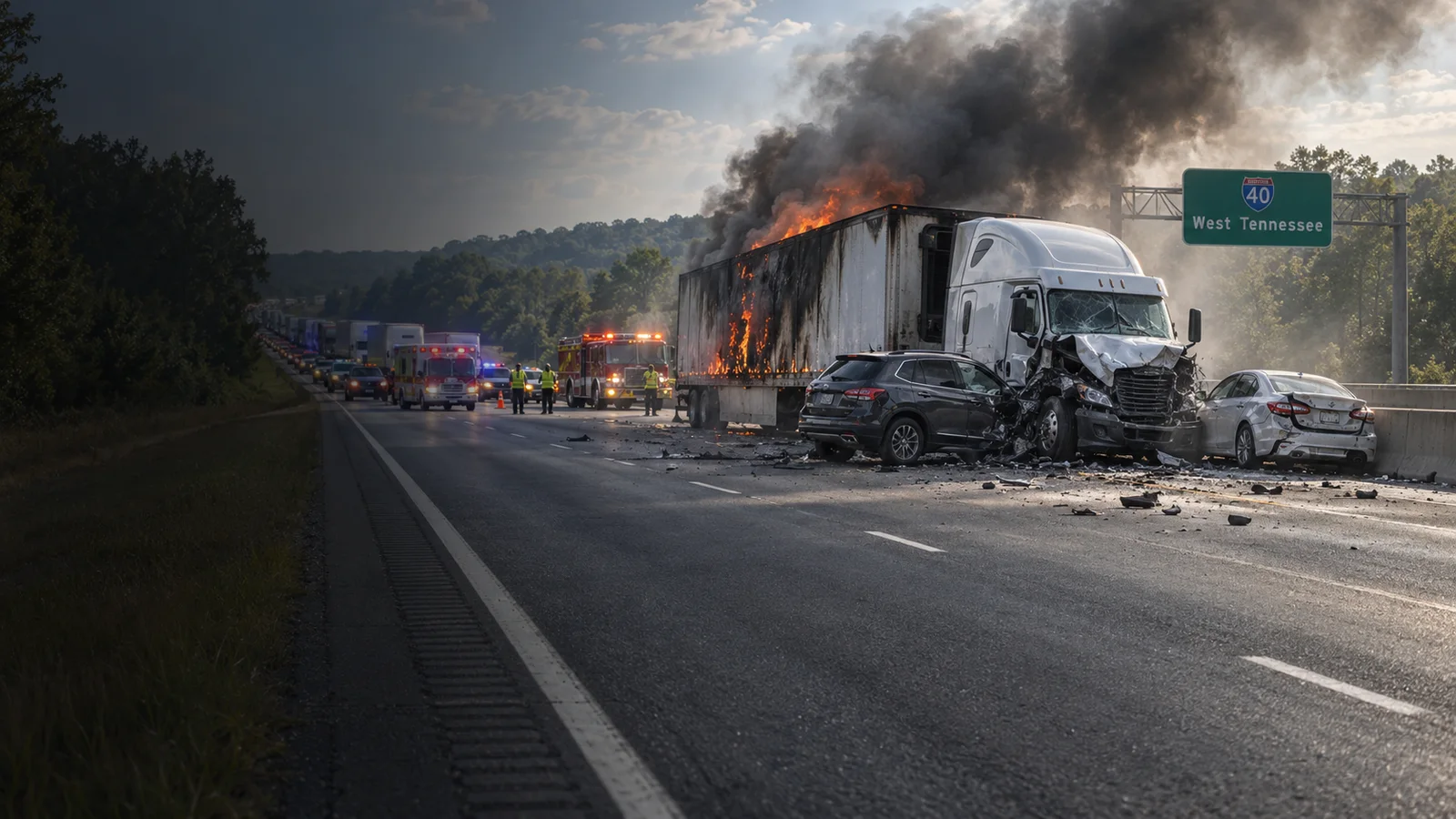
West Tennessee I-40 Truck Crash Lawyer
Legal help for people injured — and families who lost someone — in the fiery four-vehicle crash on eastbound Interstate 40 near mile marker 72–74, between Brownsville and Jackson.
No fee unless we win. Bilingual intake. Memphis office: 888-551-3865.
Confirmed by THP
Time: approximately 11:47 a.m. CDT, Tuesday, September 1, 2026.
Vehicles: two semi-trucks, a Nissan Quest, a Honda Accord.
Cause: still under investigation by the Tennessee Highway Patrol. No party has been found at fault or charged.
Main takeaways
Two commercial trucks means two carriers, two insurers, two evidence trails.
Each tractor has its own electronic logging device, engine control module, driver qualification file and maintenance history. Neither carrier has been publicly named.
The fire destroyed the physical scene, so the electronic record decides this case.
Crush profiles, tire marks and load positions burned. Speed, braking and hours-of-service data survive only on servers — and only for as long as retention rules require.
Tennessee gives you about one year, not two or three.
Tennessee's injury and wrongful death limitations period is generally one year from the date of injury or death — among the shortest in the country.
Even the county is unsettled — and it changes where a case is filed.
One station reported mile marker 74 near Brownsville in Haywood County; another reported the THP preliminary report placing it at mile marker 72 in Madison County.
Interstate trucks carry far larger insurance than cars.
Federal law requires most interstate for-hire general-freight carriers to keep at least $750,000 in liability coverage, and many carry several million in layered policies.
The THP investigation is not your investigation.
A state trooper decides whether to cite or charge. Nobody in that process is charged with proving your damages or protecting your civil claim.
Incident facts
Confirmed vs. developing| Fact | What is reported | Status |
|---|---|---|
| Date | Tuesday, September 1, 2026 | Confirmed |
| Time | Approximately 11:47 a.m. CDT, per the THP preliminary report | Confirmed |
| Location | Interstate 40 eastbound, West Tennessee, between Brownsville and Jackson. WMC reported near mile marker 74, just past the Brownsville exit; WBBJ first reported mile marker 73, then reported the THP preliminary report placing it near mile marker 72 in Madison County. | Conflicting |
| County | Haywood County per WMC's Brownsville reference; Madison County per the THP preliminary report as reported by WBBJ | Conflicting |
| Vehicles | Four: two semi-trucks, a Nissan Quest, a Honda Accord | Confirmed |
| Fatality | One. THP identified the driver who died as Farahov Fhsvaisov, 35, of New York, who was driving one of the commercial trucks. | Confirmed |
| Injuries | Three injured; two airlifted to regional hospitals | Confirmed |
| Fire | A semi-truck was fully engulfed in flames on the shoulder next to a heavily damaged vehicle. Viewer photos showed one vehicle pinned underneath the burning semi. | Confirmed |
| Road closure | TDOT closed all eastbound lanes. Exit 66 was blocked; eastbound drivers were routed to Highway 70. | Confirmed |
| Cause | Under investigation by the Tennessee Highway Patrol | Developing |
| Motor carriers | Neither trucking company has been publicly identified in any THP statement or news report as of September 7, 2026 | Not yet named |
| Citations or charges | None announced | Developing |
| Liability | No party has been found legally responsible. Fault has not been determined by any court. | Undetermined |
What happened on I-40
Shortly before noon on Tuesday, September 1, 2026, four vehicles collided in the eastbound lanes of Interstate 40 in West Tennessee, in the stretch between the Brownsville exit and Jackson. The Tennessee Highway Patrol's preliminary crash report puts the time at approximately 11:47 a.m. and identifies the vehicles as two semi-trucks, a Nissan Quest and a Honda Accord.
The collision started a fire. Photographs taken by WBBJ showed one semi-truck fully engulfed in flames along the shoulder, immediately next to a heavily damaged vehicle. Photographs submitted by Action News 5 viewers showed a vehicle pinned underneath the burning tractor-trailer.
One person was killed. THP identified the driver who died as 35-year-old Farahov Fhsvaisov of New York, who was driving one of the two commercial trucks. Three other people were injured; emergency officials confirmed that two of them were airlifted to regional hospitals.
The Tennessee Department of Transportation closed all eastbound lanes while crews worked to extinguish the truck and clear the wreckage. Exit 66 was blocked off entirely and eastbound traffic was routed onto Highway 70. THP has not released a determination of cause.
Timeline
A note on the mile marker
Three different mile markers — 72, 73 and 74 — have appeared in reporting, along with two different counties. Early crash locations are often approximate and get corrected in the final report. The controlling number is the one on the completed THP crash report, and it determines which county's court hears a case.
Electronic truck data does not wait for you to feel ready.
Federal rules require carriers to retain driver logs for six months. Engine data can be overwritten sooner. A preservation demand costs you nothing and can be sent today.
Latest investigation updates
This page tracks what has actually been released. Items are dated and sourced. Nothing is added on the basis of rumor, social media or inference.
THP releases preliminary crash report
The report states four vehicles collided causing a fire at approximately 11:47 a.m. near mile marker 72 on I-40 in Madison County, and lists the vehicles as two semi-trucks, a Nissan Quest and a Honda Accord. THP identified the driver who died as Farahov Fhsvaisov, 35, of New York, driver of one of the commercial trucks. Source: WBBJ update, 9/3/26.
Eastbound I-40 fully closed; two airlifted
TDOT closed all eastbound lanes as crews extinguished the semi-truck. Exit 66 was blocked; drivers were routed to Highway 70. Two of the three injured were airlifted. Sources: WBBJ and WMC Action News 5, 9/1/26.
What has not been released
- The names of either motor carrier, and their USDOT numbers.
- The cause of the collision, and which vehicle initiated it.
- The identities and conditions of the three injured people.
- Whether post-accident drug and alcohol testing was performed on the surviving commercial driver.
- Any citations, criminal charges, or FMCSA enforcement action.
- Whether cargo, load securement or a mechanical failure played a role.
Every company and agency involved
A crash like this pulls in state police, a state transportation department, federal regulators, at least two private trucking businesses, air ambulance providers, hospitals and several insurers. Knowing who each one is — and whose side they are on — is the difference between being processed and being represented.
Tennessee Highway Patrol
A division of the Tennessee Department of Safety and Homeland Security. THP has jurisdiction over interstate crashes, produces the official crash report, decides whether to cite or seek charges, and for serious wrecks may deploy a Critical Incident Response Team to do scene reconstruction.
Tennessee Department of Transportation
TDOT owns and maintains I-40, operates the SmartWay traffic camera and message-sign network, and closed the eastbound lanes here. TDOT crews were on scene managing traffic.
Motor carrier #1 — the burning tractor-trailer
The company that owned or operated the semi-truck that caught fire. It has not been publicly identified. Its identity is established from the THP report, the USDOT and MC numbers painted on the tractor door, the tractor VIN, and FMCSA registration records.
Motor carrier #2 — the second semi-truck
The second commercial vehicle's owner or operator, also unidentified. One of the two commercial drivers died; whether he drove the truck that burned has not been specified in reporting.
Federal Motor Carrier Safety Administration
An agency of the U.S. Department of Transportation. FMCSA writes the Federal Motor Carrier Safety Regulations (49 C.F.R. Parts 350–399), registers interstate carriers, publishes their inspection and crash history through its Safety Measurement System, and can open a compliance investigation after a fatal crash.
National Transportation Safety Board
The NTSB investigates selected highway crashes, usually those involving mass casualties or a novel safety issue. It has not announced an investigation into this crash, and most fatal truck crashes are not NTSB matters.
County fire, EMS and air medical providers
County fire and rescue units extinguished the truck fire and performed extrication. Two patients were flown by air ambulance to regional hospitals.
Nissan and Honda
A Nissan Quest and a Honda Accord were among the four vehicles. Naming a make and model is not an allegation against a manufacturer. No defect has been identified, alleged or reported in connection with this crash, and neither company has been accused of anything.
Commercial insurers and their adjusters
Each carrier will have a liability insurer, and large fleets often use third-party administrators and rapid-response teams that reach a crash scene within hours. Their adjusters are trained, experienced and paid to limit payouts.
Freight brokers, shippers and equipment lessors
Commercial freight often involves a broker who arranged the load, a shipper who owned and loaded it, and a leasing company that owns the tractor or trailer. None of these parties is known here because the loads and equipment have not been identified.
Potentially liable parties
Nothing below is an accusation. No party has been found at fault by the Tennessee Highway Patrol or by any court, and no citations or charges have been announced. This is a list of the legal theories a Tennessee lawyer would investigate in a crash with these characteristics — nothing more.
| Party | Theory a lawyer would investigate | Evidence it turns on |
|---|---|---|
| The commercial drivers | Ordinary negligence — following too closely, unsafe speed for conditions, failure to keep a proper lookout, improper lane change, fatigued driving. | ELD hours-of-service logs, engine control module speed and brake data, dash camera, THP reconstruction. |
| The motor carriers | Vicarious liability for a driver acting in the scope of employment, plus independent claims for negligent hiring, training, retention, supervision, and negligent entrustment. | Driver qualification files, prior violation history, training records, dispatch pressure, pay structure. |
| The carriers, on maintenance | Negligent inspection, repair and maintenance under 49 C.F.R. Part 396 — brakes, tires, lighting, fuel system integrity. | Annual inspection reports, driver vehicle inspection reports, repair invoices, roadside inspection history. |
| Passenger vehicle drivers | Comparative fault. In Tennessee any party's share can be assessed, including a plaintiff's. | Event data recorders, witness statements, scene geometry. |
| Freight broker | Negligent selection of an unsafe carrier, where a broker chose a carrier with a poor safety record. Federal preemption of this claim is contested and varies by circuit. | Broker–carrier agreement, load confirmation, the carrier's FMCSA record at time of booking. |
| Shipper | Negligent loading or securement, particularly where a defect in the load was not apparent to the driver. | Bills of lading, seal records, loading photographs, weight tickets. |
| Tractor or trailer lessor | Liability arising from equipment ownership and lease arrangements under 49 C.F.R. Part 376, including the carrier's responsibility for leased equipment it operates. | Lease agreements, placarding, maintenance responsibility clauses. |
| Component or vehicle manufacturers | Product liability under the Tennessee Products Liability Act, if expert examination were to show a defect — for example in a brake system, underride guard or fuel system. No defect has been alleged here. | Physical inspection of preserved vehicles, recall history, FMVSS compliance testing. |
| Maintenance contractor | Negligent repair, where a third-party shop serviced a tractor or trailer before the crash. | Work orders, parts invoices, technician certifications. |
| Roadway or work-zone entities | Negligent design, signage or traffic control, if conditions at that segment contributed. Claims against the State of Tennessee run through the Tennessee Claims Commission and are subject to immunity and damage caps. | TDOT maintenance and work-zone records, SmartWay footage, prior crash history for the segment. |
Could the trucking companies face liability?
Carrier not yet namedThe honest answer is that it depends entirely on facts that have not been released — and that the analysis does not require the driver to have done anything wrong.
Why a carrier is usually on the hook for its driver
Under respondeat superior, an employer is responsible for the negligence of an employee acting within the scope of employment. If a commercial driver here was negligent and was working, his employer is answerable for that negligence without any separate wrongdoing by the company. Interstate motor carriers also cannot escape responsibility by labeling a driver an independent contractor as easily as other businesses can, because federal leasing and control regulations attach responsibility to the carrier operating under its own authority.
Why a carrier can be liable even if the driver was careful
Direct negligence claims target the company's own conduct rather than the driver's. Courts routinely examine whether a carrier hired a driver with a disqualifying record, skipped required background and qualification steps, failed to train on the conditions the route demanded, ignored prior hours-of-service violations, built a dispatch schedule that could not be met legally, or deferred maintenance on brakes or tires. Each of those is a company decision, documented in company files.
What would have to be true
For either carrier here to face civil liability, an injured person would have to establish, by a preponderance of the evidence, that the carrier or its driver breached a duty of care and that the breach caused the harm. None of that has been established. THP has not stated a cause, no citations have been announced, and neither company has been identified — so any statement that a specific trucking company is responsible would be unsupported today.
Signals we look for the moment a carrier is named
- Out-of-service rates for driver and vehicle inspections against the national average.
- Hours-of-service and fatigued-driving violations in the prior 24 months.
- Unsafe driving and vehicle maintenance category scores in FMCSA's Safety Measurement System.
- Prior crash history, and whether the crash rate is rising.
- Whether the carrier's registration, insurance filing and authority were active and adequate.
- Whether the carrier has been the subject of a compliance review or a conditional safety rating.
- Whether the tractor or trailer was leased, and from whom.
- Whether a broker placed the load, and what it knew about the carrier's record.
Federal minimum coverage
Most interstate for-hire carriers hauling general freight in vehicles over 10,000 pounds must maintain at least $750,000 in public liability coverage under 49 C.F.R. § 387.9. Higher minimums apply to certain hazardous materials. Larger fleets often carry excess layers well beyond the minimum. This is why identifying the carrier matters so much more than identifying the driver.
Government investigation vs. civil investigation
These run in parallel, ask different questions, and produce different documents. People are often surprised to learn the state investigation is not building their claim.
| Government investigation (THP / FMCSA) | Civil investigation (your lawyer) | |
|---|---|---|
| Question it answers | Was a traffic law or safety regulation violated? Should anyone be cited or charged? | Who is legally responsible, and what is the full extent of the harm they caused? |
| Who it works for | The State of Tennessee and the public. | You. |
| Standard of proof | Probable cause to cite; beyond a reasonable doubt to convict. | Preponderance of the evidence — more likely than not. |
| Speed | A preliminary report in days; a completed report often in weeks. Cause determinations can take months. | Preservation demands can go out within days. Independent reconstruction can begin before the state finishes. |
| Power it has | Scene control, mandatory post-accident testing, subpoena and arrest powers, regulatory enforcement against a carrier. | No police powers before suit. After filing: subpoenas, depositions under oath, document discovery, court-ordered vehicle inspections. |
| What it will not do | It will not calculate your medical costs, lost income, or the value of a life. It will not preserve a carrier's internal files for you. Its findings are not binding on a civil jury. | It will not decide guilt or impose fines. It cannot compel testimony until a case is filed. |
| Document it produces | The Tennessee crash report, trooper narrative and diagram, any citation, and — if FMCSA opens one — a compliance review record. | Preservation letters, an independent reconstruction, medical and economic damages reports, deposition transcripts, and ultimately a complaint filed in court. |
| How you get it | Request through the Tennessee Department of Safety and Homeland Security; other records via public-records request. | Your lawyer builds and holds it. It is privileged work product. |
The Tennessee law that controls this crash
Because the crash happened in West Tennessee, Tennessee substantive law governs — regardless of where any driver, carrier or vehicle came from. Several features of Tennessee law are unusually consequential here.
One year to file — Tenn. Code Ann. § 28-3-104
Tennessee's limitations period for personal injury and for wrongful death is generally one year, running from the date of injury or the date of death. It is one of the shortest in the United States. If a defendant is criminally charged for conduct arising out of the same accident, the statute provides an extension to two years. Whether that extension applies here depends on charging decisions that have not been made.
Modified comparative fault — McIntyre v. Balentine
Tennessee abandoned contributory negligence in 1992. An injured person may recover so long as their own fault is less than 50%, with the award reduced by their percentage. A driver told at the scene that they were partly to blame is not necessarily barred from recovering, and defense-assigned fault is an allocation to be litigated rather than a fact.
Caps on non-economic damages — § 29-39-102
Tennessee generally caps non-economic damages such as pain, suffering and loss of enjoyment of life at $750,000, raised to $1,000,000 for statutorily defined catastrophic loss including certain severe burns and the wrongful death of a parent leaving minor children. Statutory exceptions remove the cap in defined circumstances, including where a defendant was intoxicated or intentionally destroyed records. Economic damages — medical bills, lost earnings, future care — are not capped.
Wrongful death — § 20-5-106 et seq.
Tennessee's wrongful death action preserves the decedent's own cause of action and passes the right to bring it to a statutory hierarchy of beneficiaries, beginning with a surviving spouse and then children or next of kin. Recoverable damages include the decedent's medical and funeral expenses, the pain and suffering he endured before death, and the pecuniary value of the life lost. Since Jordan v. Baptist Three Rivers Hospital, that value has included the loss of consortium suffered by a spouse and children.
Punitive damages — § 29-39-104
Punitive damages in Tennessee require clear and convincing evidence of intentional, fraudulent, malicious or reckless conduct, and are capped at the greater of two times compensatory damages or $500,000. In trucking cases they are typically pursued where a carrier knowingly disregarded a safety regulation rather than for ordinary driving errors.
Where a case would be filed
If the crash site is confirmed in Haywood County, state venue lies in the Haywood County Circuit Court; if in Madison County, the Madison County Circuit Court. Both counties sit within the Eastern Division of the U.S. District Court for the Western District of Tennessee, which is where a case against out-of-state carriers is often filed on diversity grounds. Venue affects the jury pool, the scheduling and, in practice, case value.
Claims involving the State
Any claim touching TDOT's design or maintenance of I-40 proceeds against the State through the Tennessee Claims Commission and is subject to sovereign immunity, notice requirements and statutory damage limits that are far lower than a claim against a private company. These are narrow, technical claims with their own deadlines.
Federal regulations layered on top
Because both trucks were commercial vehicles, the Federal Motor Carrier Safety Regulations supply the standard of care: Part 391 driver qualification, Part 382 drug and alcohol testing including post-accident testing, Part 395 hours of service and electronic logging, Part 396 inspection and maintenance, and Part 392 driving rules. A proven regulatory violation is powerful evidence of negligence in a Tennessee courtroom.
Attorney analysis
Original commentarySix observations specific to this crash from Orville Dunk, who owned and operated trucking companies before he became a trial lawyer. These are professional opinions about what to investigate, not conclusions about fault.
Two commercial vehicles changes the whole shape of the case.
Most fatal truck wrecks have one carrier defendant. This one appears to have two. That means two driver qualification files, two sets of electronic logs, two maintenance histories and two insurance towers — and it means the two carriers have every incentive to blame each other. For an injured motorist in the Quest or the Accord, that dynamic tends to work in their favor: the defendants develop each other's bad facts. It also means a preservation demand has to go to two companies at once, and missing one is a real loss.
Fire moves the case from the roadside to the server room.
When a tractor burns to the frame, the evidence a reconstructionist normally relies on — crush measurement, tire witness marks, lamp filament analysis, load position — is degraded or gone. What survives is electronic: engine control module speed, throttle and brake history, electronic logging device duty status, telematics pings, dash camera uploads, and dispatch messaging. Fleets do not keep all of that indefinitely. Federal rules require carriers to retain records of duty status for six months; engine data can be overwritten with continued operation or lost when a unit is scrapped. Every week that passes without a preservation demand is a week of quiet risk.
A vehicle pinned under a trailer raises the underride question.
Viewer photographs published by Action News 5 showed a vehicle pinned underneath the burning semi. When a passenger vehicle ends up beneath a trailer, the condition and adequacy of the rear impact guard and any side protection becomes a live engineering question, along with trailer conspicuity markings and lighting. Answering it requires the trailer itself, inspected and photographed before it is repaired or scrapped. This is one of the strongest practical reasons to place a hold on the equipment early — the question cannot be reconstructed later from a report.
Midday on a rural interstate points the inquiry toward the load and the schedule.
This was not a dark, wet, 3 a.m. crash. It happened around 11:47 a.m. on a straight, well-known stretch of I-40, in daylight. That does not tell us what happened, and no cause has been released. What it does tell an investigator is where to look first: how far into the driving window each driver was, what the dispatch schedule demanded, whether traffic had slowed ahead, whether either combination was overweight or improperly loaded, and whether brake condition or adjustment was a factor. Those questions are answered from logs and inspection records, not from photographs.
The location dispute is a legal issue, not a typo.
Mile marker 72 in Madison County and mile marker 74 near Brownsville in Haywood County have both been reported by credible outlets citing the same investigating agency. It is a routine discrepancy and it will be resolved on the final report. But it determines which county's circuit court has venue, which jury pool hears the case, and which county's records custodians hold the response documents. It is worth pinning down early rather than assuming.
The commercial driver's family has a claim of its own — against different parties.
The person who died was working. If he was an employee, workers' compensation is generally the exclusive remedy against his own employer, but it does not bar a wrongful death action against a third party — including the other carrier and its driver — and it does not bar claims against equipment manufacturers or maintenance contractors. Those cases involve a compensation lien, coordination between two sets of counsel, and a different beneficiary analysis under Tennessee's wrongful death statute. Families in this position are frequently told, incorrectly, that they have no case beyond comp.
Want this analysis applied to your own facts? That conversation is free and it is with an attorney.
Evidence preservation checklist
Tick each item as it is secured. Your progress is saved on this device. Items marked time-critical can be lost permanently within weeks.
Held by the trucking companies — time-critical
Physical, public and personal
What victims and families should do now
Get evaluated, even if you walked away.
Adrenaline masks injury. Traumatic brain injury, internal bleeding and spinal damage are routinely missed on the day of a crash. A gap between the crash and your first medical visit is the first thing an adjuster will use against you.
Do not give a recorded statement to a trucking insurer.
You are not required to. Trucking insurers deploy rapid-response teams within hours. Be polite, take the adjuster's name, claim number and company, and say you will follow up through counsel.
Do not sign anything, and do not accept a quick check.
Early releases and broad medical authorizations are routinely presented before anyone knows the true cost of an injury. Signing a release ends the claim permanently.
Find out where your vehicle is stored — today.
Call the tow yard and tell them in writing not to sell, scrap or repair it. Wrecked vehicles are the most commonly lost piece of evidence in a truck case.
Stay off social media about the crash.
Posts, photos, check-ins and comments are collected by the defense and used to argue your injuries are exaggerated. Ask family to do the same.
Request the THP crash report.
Order it through the Tennessee Department of Safety and Homeland Security. Read it carefully — names, mile marker, county and vehicle details are sometimes wrong and corrections matter.
Preserve your own records before the paperwork starts.
Keep every bill, explanation of benefits, mileage log and out-of-pocket receipt in one place. Start a dated journal today while your memory is intact.
If someone died, wait before opening an estate on your own.
Tennessee's wrongful death statute directs the right of action to specific beneficiaries in order. Getting the representative capacity right at the start avoids a fight later.
Talk to a trucking lawyer while the data still exists.
The consultation is free and there is no obligation. A preservation letter can go out the same day.
Call 888-551-3865Possible compensation
What follows are the categories Tennessee law recognizes. It is not a prediction. Nobody can value a claim before the medical picture is complete and the carriers' coverage is known, and any lawyer who quotes you a number in a first phone call is guessing.
Economic damages — not capped
- Emergency response, air ambulance and hospital charges
- Surgery, rehabilitation, medication and durable equipment
- The reasonable cost of future medical care and life care planning
- Lost wages and lost earning capacity, including diminished career trajectory
- Household services you can no longer perform
- Property damage, towing, storage and vehicle replacement
- Out-of-pocket costs, travel to treatment and home modification
Non-economic damages — capped by statute
- Physical pain and suffering, including burn pain
- Mental anguish, and post-traumatic stress after a fire crash
- Permanent impairment, scarring and disfigurement
- Loss of enjoyment of life
- Loss of consortium for a spouse and children
Generally limited to $750,000, or $1,000,000 for statutorily defined catastrophic loss, with statutory exceptions that can remove the cap entirely.
Wrongful death damages
- Final medical expenses and funeral and burial costs
- The pain and suffering the person endured before death
- The pecuniary value of the life lost — earnings, services and expectancy
- Loss of the decedent's love, society, companionship and guidance to a spouse and children
Punitive damages — narrow and capped
Available only on clear and convincing evidence of intentional, fraudulent, malicious or reckless conduct, and capped at the greater of two times compensatory damages or $500,000. In trucking litigation they are usually reserved for a carrier's knowing disregard of a safety rule — falsified logs, a driver kept on the road after disqualifying violations, or deferred brake repair.
Sources of recovery beyond the carriers
Your own uninsured and underinsured motorist coverage, medical payments coverage, health insurance, and in some cases workers' compensation if you were working when the crash occurred. These interact, and each brings subrogation and lien issues that should be coordinated rather than handled one at a time.
What reduces a recovery
Your own percentage of comparative fault, statutory caps, available policy limits, hospital and insurer liens, and delay in treatment. Most of these can be managed, and several can be reduced through negotiation — but only by someone who is looking at them from the start.
How Dunk Law Firm can help
Dunk Law Firm is a national personal injury firm with a Tennessee office in Memphis, roughly an hour west of this stretch of I-40, and attorneys licensed in Tennessee. Firm-wide, its reported recoveries include $20 million and $5 million wrongful death trucking cases.
Founding attorney Orville Dunk owned and ran trucking companies before he practiced law. That is an unusual background for a plaintiff's lawyer and it matters in a case like this one: driver logs, DOT files, maintenance deferrals and dispatch pressure are documents he handled from the other side of the desk.
Where a matter calls for it, the firm associates Tennessee counsel with the right local knowledge — the Haywood and Madison County circuit courts and the Western District of Tennessee at Jackson each have their own practices and personalities. You are told who is on your case at the outset, and it does not change without your knowing.
Terms, plainly
Free consultation. Contingency fee — no fee unless there is a recovery. No out-of-pocket cost for case work or court costs. Cash advance funding available for qualifying cases. Bilingual Spanish–English intake. Phones answered 24 hours a day.
What happens in the first 72 hours
Reach us
888-551-3865
Tell us what happened on I-40.
Two minutes is enough to start. An attorney reviews what you send and calls you back. It is free, confidential, and there is no obligation. If you would rather speak to someone right now, call 888-551-3865 — the line is answered 24 hours a day, in English or Spanish.
- A real attorney reviews your case, not a call center
- No fees unless we win
- We take over the adjuster calls
- A preservation letter can be sent the same day
Written and legally reviewed by

Orville Dunk
Founding Attorney · Dunk Law Firm, PLLC
Orville Dunk founded Dunk Law Firm in 2004 and has spent more than two decades representing people in wrongful death, catastrophic injury and commercial trucking cases. Before practicing law he owned and operated trucking companies, which is where he learned driver logs, DOT compliance files, maintenance records and how carriers and their insurers handle a serious crash. He was born in May Pen, Jamaica, and built the firm from the ground up.
The firm has offices in Houston, Memphis, Milwaukee and St. Louis, and handles Tennessee matters from its Memphis office. Attorney Dunk appears regularly on local radio, including Univision and 100.7 KKHT, discussing injury victims' rights.
Recognition
- AV Preeminent — Martindale-Hubbell
- Litigator of the Year, 2020
- National Top 40 Under 40 Trial Lawyers
- American Institute of Trial Lawyers
- Lawyers of Distinction
- Who's Who Top Attorneys
- 20+ years in practice; firm founded 2004
Reported firm recoveries include $20M and $5M wrongful death trucking cases and a $13M plant explosion case. Past results do not guarantee a similar outcome; every case is different.
Page provenance
Published: September 7, 2026
Last legal review: September 7, 2026
Factual basis: Tennessee Highway Patrol statements and preliminary crash report as reported by WBBJ (Jackson) and WMC Action News 5 (Memphis).
Next scheduled review: on release of the completed THP crash report, or sooner if the motor carriers are identified.
Questions about this crash
Do I actually need a lawyer for this crash, or can I handle it with the insurance company?
How long do I have to file a claim in Tennessee?
Which trucking companies were involved?
Where exactly did the crash happen? I have seen different mile markers.
What does it cost to hire Dunk Law Firm?
A trucking insurance adjuster already called me. Did I hurt my case?
What is a case like this worth?
Two people were airlifted. Who pays for a medical helicopter?
Our family lost someone. Who has the right to bring a wrongful death claim in Tennessee?
The driver who died was working. Does his family only get workers' compensation?
What if part of this was my fault?
The truck burned. Isn't the evidence gone?
How long will a case like this take?
I don't live in Tennessee. Can I still bring a claim here, and do I have to travel?
Official and primary sources
Reporting this page relies on
- WBBJ 7 News — “1 dead, 3 injured in fiery multi-vehicle crash on I-40 near mile marker 73”, published Sept. 1, 2026, updated Sept. 3, 2026 with the THP preliminary report.
- WMC Action News 5 — “1 dead, 3 injured in fiery multi-vehicle crash on I-40 near Brownsville”, published Sept. 1, 2026, updated Sept. 3, 2026.
Agencies and records
- Tennessee Department of Safety and Homeland Security — Tennessee Highway Patrol; crash report requests.
- Tennessee Department of Transportation and TDOT SmartWay — traffic cameras and incident information for I-40.
- Federal Motor Carrier Safety Administration; carrier lookup via SAFER Company Snapshot and Safety Measurement System.
- National Transportation Safety Board — no investigation announced for this crash.
Law cited
- Tenn. Code Ann. § 28-3-104 — one-year limitations period for personal injury and wrongful death.
- Tenn. Code Ann. § 20-5-106 et seq. — wrongful death right of action and beneficiaries.
- Tenn. Code Ann. § 29-39-102 — cap on non-economic damages; § 29-39-104 — punitive damages.
- Tenn. Code Ann. § 29-28-101 et seq. — Tennessee Products Liability Act.
- McIntyre v. Balentine, 833 S.W.2d 52 (Tenn. 1992) — modified comparative fault.
- Jordan v. Baptist Three Rivers Hosp., 984 S.W.2d 593 (Tenn. 1999) — consortium in wrongful death.
- 49 C.F.R. Parts 382, 390–396 — Federal Motor Carrier Safety Regulations; § 387.9 — minimum liability coverage; Part 376 — leasing.
Breaking news accuracy notice
This page was assembled from news reporting about an incident that is still under investigation. Early crash reporting is frequently revised: mile markers, counties, vehicle counts, names and injury counts all change as agencies complete their work. Two outlets citing the same agency have already reported different mile markers and different counties for this crash. Where accounts conflict, this page shows both and identifies which is which rather than choosing one.
Nothing here is a finding of fault. The Tennessee Highway Patrol has not released a cause. No citations or criminal charges have been announced, no motor carrier has been publicly identified, and no court has determined that any person or company is legally responsible. References to legal theories, potentially liable parties and regulations describe what a lawyer would investigate — they are not allegations against anyone, and they are not conclusions.
This page is attorney advertising and general legal information about Tennessee law. It is not legal advice, and reading it does not create an attorney–client relationship with Dunk Law Firm, PLLC. Statutes, regulations and case law change, and their application depends on facts specific to each person. If you were affected by this crash, speak with a licensed Tennessee attorney about your own situation. Prior results do not guarantee a similar outcome. If you believe anything on this page is inaccurate or out of date, please contact us so it can be corrected.
If you were hurt on I-40 on September 1 — or you lost someone — the call is free, the line is answered 24 hours a day, and you owe nothing unless there is a recovery.
It is time to dunk on the insurance companies.
Memphis office · 149 Monroe Ave., Memphis, TN 38103 · 888-551-3865 · Se habla español · Available 24/7